
If you have spent any time online in the last year, you have probably run into both terms floating around in the same breath: generative AI and agentic AI. They sound related, and in a way they are, but they are not describing the same thing at all. A lot of the confusion comes from marketing teams slapping the word “agentic” onto tools that are still mostly just responding to prompts, which makes the whole conversation feel muddier than it needs to be.
This article breaks down agentic AI vs generative AI in plain, practical language, without assuming you already have a computer science background. By the end, you should have a clear picture of what separates the two, where each one actually shines, and why this distinction has become one of the most important things to understand about AI heading into 2026.
What Generative AI Actually Does
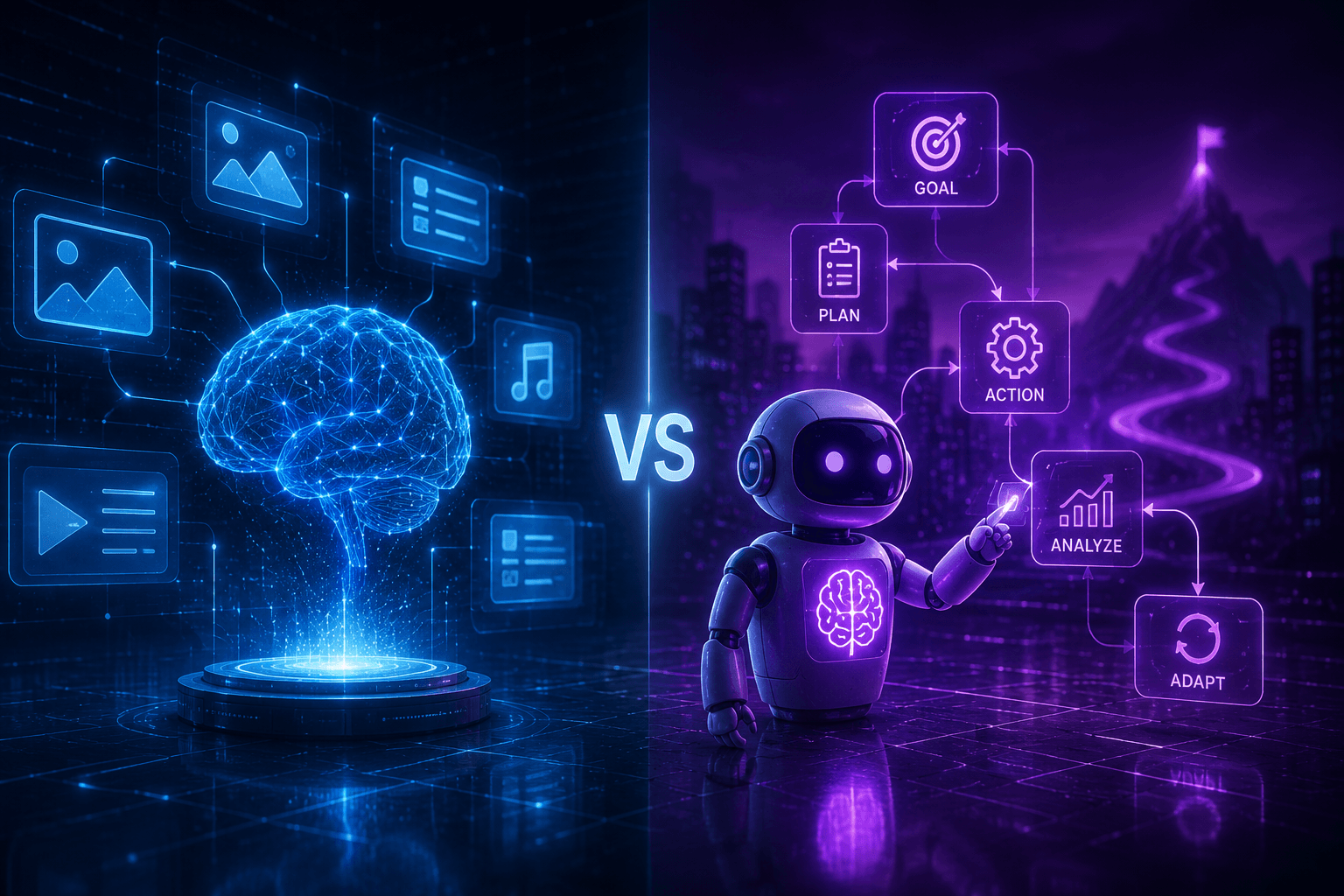
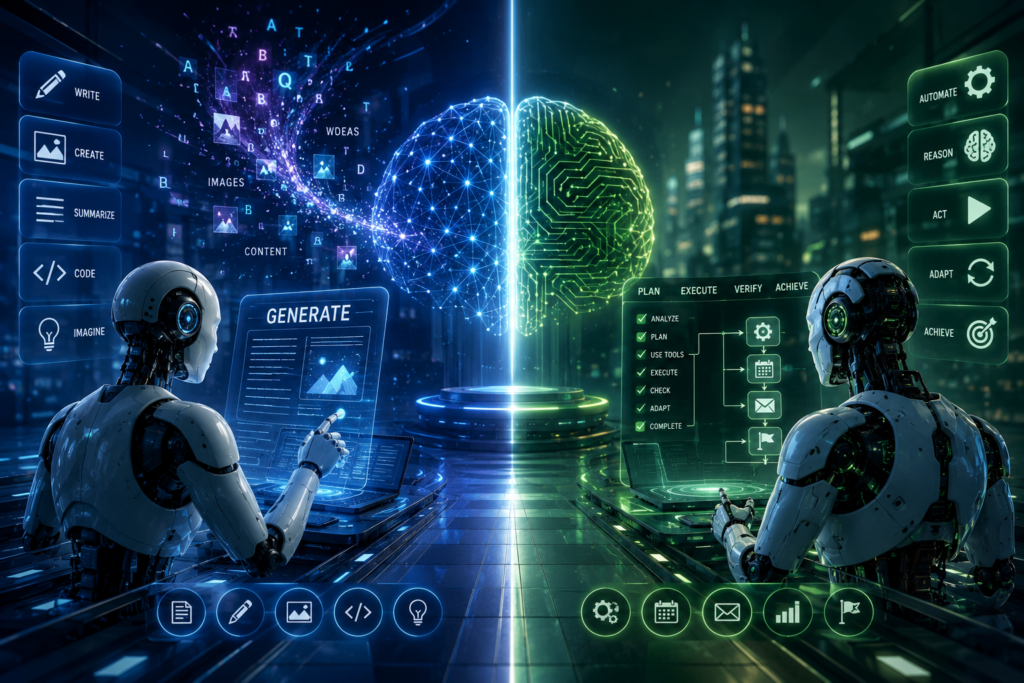
Generative AI is the technology most people already have hands-on experience with, even if they never used that exact term for it. Tools like ChatGPT, Claude, Gemini, and Midjourney fall into this category. At its core, generative AI takes a prompt, whether that’s a question, an instruction, or a request for an image, and produces new content in response: text, pictures, code, audio, or video.
The defining trait here is that generative AI is reactive. It waits for you to ask for something, does its best to generate a high-quality response, and then stops. It does not keep working on a project after that single response unless you prompt it again. This has made it enormously useful for writing assistance, brainstorming, image creation, summarizing documents, and drafting code, but it has a natural ceiling: it only does what you explicitly ask, one exchange at a time.
What Agentic AI Adds to the Picture
Agentic AI takes that same underlying technology and wraps it inside something more capable of independent action. Rather than just answering a single prompt, an agentic system can break a broader goal down into smaller steps, decide what needs to happen next, use external tools or software to carry out those steps, check whether the outcome matches what was intended, and adjust its approach if something didn’t go as planned.
A simple way to picture this difference is to imagine asking for help with your inbox. A generative AI tool will write a reply if you ask it to. An agentic AI system can read through unanswered emails, draft responses, check your calendar for availability, schedule a meeting based on what it finds, and then report back on what it did, all without you walking it through each step. That is the heart of agentic AI vs generative AI: one produces an output when asked, and the other pursues an outcome on its own.
The Technology Underneath Both
It is worth pointing out that agentic AI is not a completely separate technology built from scratch. Agentic systems almost always rely on generative AI models as their core reasoning engine. Every time an agent needs to decide what step comes next, it typically calls on a large language model, the same type of technology powering standard generative tools, to think through the situation and choose an action.
A useful analogy here is thinking of generative AI as an engine and agentic AI as the full vehicle built around that engine, complete with steering, sensors, and a destination in mind. Framing agentic AI vs generative AI as rivals is a bit misleading, since agentic systems are effectively built on top of generative capabilities rather than replacing them entirely.
Autonomy Is the Key Dividing Line
If there is one word that captures the core of this comparison, it is autonomy. Generative AI has none essentially. It waits for input and produces output, and that is where its involvement ends until you prompt it again. Agentic AI is built specifically to operate with much less hand-holding, making decisions across multiple steps and adjusting its plan based on results it observes along the way.
This is also why agentic systems are often described as having memory and context that persists across a task. At the same time, a typical generative AI interaction can be treated as a fresh start each time you begin a new conversation. When people ask about agentic AI vs generative AI and want the shortest possible answer, autonomy is usually the concept that explains the distinction most clearly.
Where Generative AI Excels
Generative AI remains extremely strong at tasks centered on creativity, pattern recognition, and content production. Writing marketing copy, generating design concepts, summarizing long documents, translating text, and producing illustrations or music are all areas where generative AI continues to deliver enormous value. Because it responds directly to a prompt, it also tends to be predictable and easy to control in a single exchange, which makes it well suited to tasks where a human wants to stay closely involved in reviewing and guiding each output.
For businesses and individuals who mainly need help producing content rather than executing multi-step processes, generative AI alone is often more than sufficient, and there is no real need to layer agentic capability on top of it.
Where Agentic AI Excels
Agentic AI becomes valuable once a task grows more complex than a single request and response. Processing an expense report from start to finish, monitoring a system and automatically resolving common issues, managing a multi-step customer service interaction, or coordinating a research task across multiple sources are all better suited to an agentic approach, since they require judgment, sequencing, and follow-through rather than one clean answer.
Enterprises exploring automation at scale have increasingly turned toward agentic systems for exactly this reason. The appeal is not that agentic AI is smarter in a general sense, but that it is structured to keep working toward a goal rather than stopping after a single output, which matters enormously for workflows with many moving parts.
Risk and Oversight Considerations
One area where agentic AI vs generative AI becomes especially important to understand is risk. Generative AI’s main risks tend to be informational: producing inaccurate content, reflecting bias present in training data, or generating something misleading if not reviewed carefully by a human. These risks are real but generally contained to the content itself.
Agentic AI introduces a different category of risk because it takes real actions rather than just producing text or images. An agent with permission to send emails, modify records, or make purchases on your behalf poses operational risk if it makes an incorrect decision partway through a task. This is why governance, oversight, and clear boundaries around what an agentic system is allowed to do have become such a major focus for organizations adopting this technology, since accountability for autonomous actions is a much bigger conversation than accountability for a single generated paragraph.
Why 2026 Is a Turning Point
For the past few years, most of the public conversation around AI centered on generative tools, largely because that was the technology most accessible to everyday users. Agentic AI existed conceptually well before now, but only recently have the underlying models become reliable enough, and the surrounding frameworks mature enough, for agentic systems to move from experimental demos into everyday operational use.
This shift is a big part of why the agentic AI vs generative AI comparison has become such a common search and discussion topic recently. Businesses are no longer just curious about what agentic AI could theoretically do; they are actively evaluating whether it can deliver measurable results against real goals, timelines, and budgets, which naturally raises the question of how it differs from the generative tools they may already be using.
How to Decide Which One You Need
Choosing between the two really comes down to the shape of the task at hand. If what you need is a single, well-defined output, a piece of writing, an image, a code snippet, or a quick summary, generative AI on its own is usually the right tool, since it is simpler, more predictable, and easier to review in one pass.
If instead you are dealing with a process that involves multiple steps, decisions that depend on earlier outcomes, or coordination across different tools and systems, an agentic approach is worth considering. Many real-world products actually sit somewhere in the middle of this spectrum, offering mostly generative behavior with a bit of agentic capability layered on, so it helps to judge a tool by what it actually does rather than by whatever label it has been marketed with.
The Two Are Increasingly Used Together
Rather than picking one over the other permanently, many organizations are finding that the two approaches complement each other well. Generative AI can handle the creative or content-producing piece of a workflow, while an agentic layer manages the sequencing, tool use, and follow-through needed to complete a broader task. This combination is quickly becoming the norm rather than the exception, which is another reason why understanding agentic AI vs generative AI matters even for people who are not deeply technical.
Rather than viewing this as a competition between two technologies, it is more accurate to see agentic AI as an extension built on top of generative capability, designed to carry a single output further into a completed outcome.
Final Thoughts
The clearest way to sum up agentic AI vs generative AI is this: generative AI creates, and agentic AI acts. One produces content when prompted, and the other pursues a goal across multiple steps with far less need for constant human direction. Both rely on similar underlying technology, but the way they are applied and the level of autonomy involved set them apart in meaningful ways. As more businesses and individuals adopt AI tools going into 2026, understanding this distinction will make it much easier to choose the right technology for the right job, rather than getting lost in marketing language that blurs the line between the two.
Frequently Asked Questions
What is the simplest way to explain agentic AI vs generative AI?
Generative AI creates content in response to a prompt, while agentic AI takes multi-step actions to accomplish a broader goal with minimal ongoing human input.
Is agentic AI more advanced than generative AI?
Not exactly. Agentic AI typically uses generative AI models as its reasoning engine, so it is better described as an extension built on top of generative capability rather than a separate, more advanced technology.
Can generative AI become agentic AI?
A generative AI model can be placed inside an agentic framework that gives it the ability to plan, use tools, and take actions, effectively turning it into part of an agentic system.
Which is riskier, agentic AI or generative AI?
Generative AI carries informational risks like inaccurate or biased content, while agentic AI carries operational risks since it can take real actions, which generally requires stronger oversight and governance.
Do businesses need to choose one over the other?
Not necessarily. Many organizations use generative AI for content creation and agentic AI for executing multi-step processes, often combining both within the same workflow.
Why is agentic AI becoming more popular in 2026?
Improvements in model reliability, better agent frameworks, and growing enterprise demand for automation have made agentic AI practical for real operational use rather than just experimentation.
How can I tell if a tool is truly agentic or just marketed that way?
Look at whether the tool can independently plan multiple steps, use external tools, and adjust its actions based on results, rather than simply producing a single response to one prompt.
