

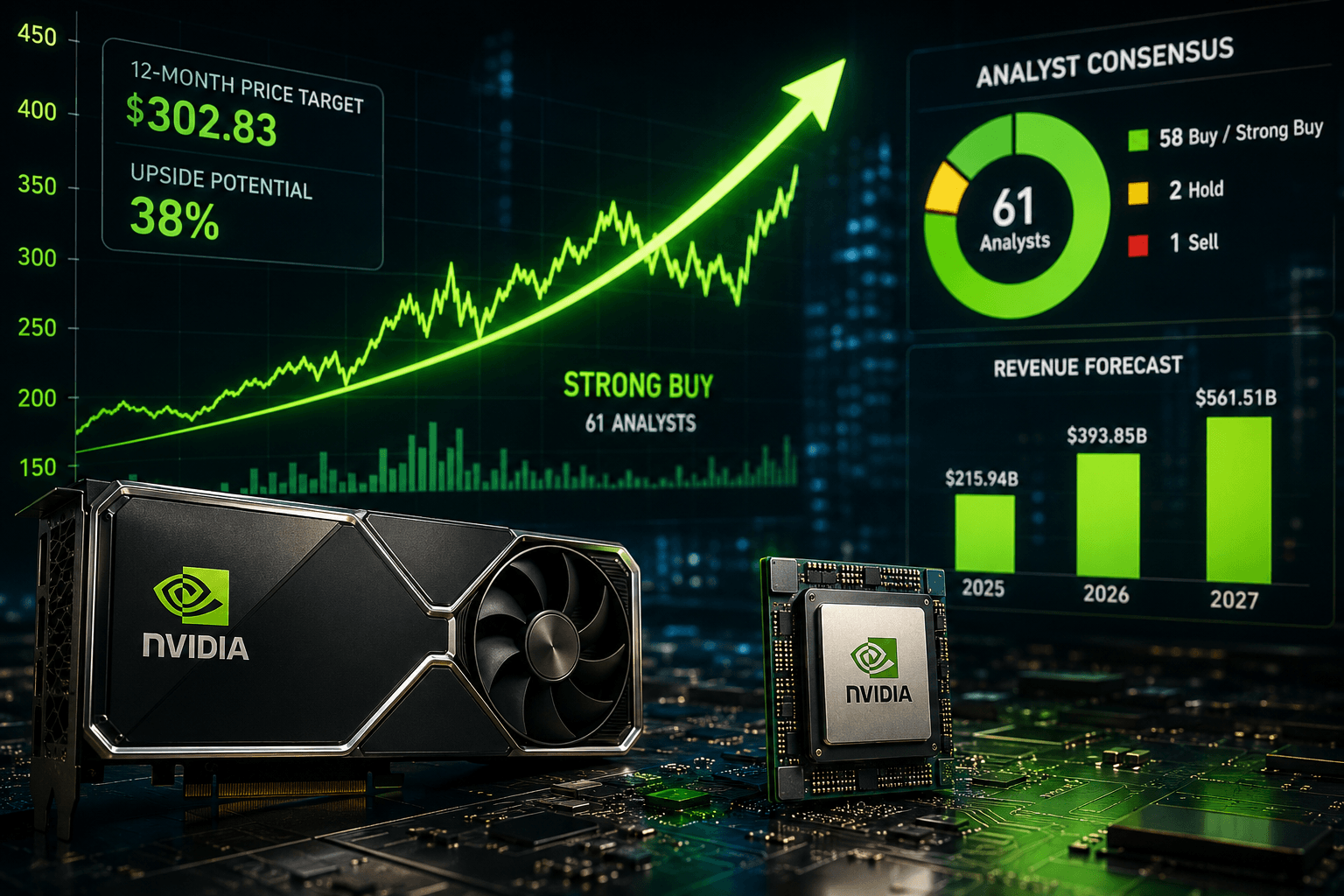
Most headlines about Nvidia’s outlook this year swing between two extremes: either the stock is about to triple, or the AI bubble is finally popping. Neither framing holds up particularly well against what analysts and the company’s own numbers are actually saying right now. As of early August 2026, the realistic Nvidia stock forecast 2026 sits closer to steady, well-supported upside than either a moonshot or a collapse, with 61 Wall Street analysts putting an average 12-month price target of $302.83 on a stock trading around $219.
That gap, roughly 38% upside from current levels, is real, but it comes wrapped in more nuance than most quick-hit articles bother to explain properly.
The Numbers Wall Street Is Actually Using
According to S&P Global’s polling of 61 analysts, Nvidia carries a “Strong Buy” consensus rating, with 58 analysts rating it Buy or Strong Buy, two at Hold, and one Sell. The average price target of $302.83 implies a fairly aggressive move from the roughly $219 the stock traded at on August 5, but the spread between individual estimates tells its own story: targets range from a low of $180 to a high of $500.
That’s not a small spread. A $320 gap between the most bearish and most bullish analyst on the same stock is a signal in itself, and it suggests that even professionals paid to price this stock precisely can’t agree on how much of Nvidia’s growth is already reflected in the share price.
Zacks Research upgraded Nvidia to a Strong Buy rating on July 20, 2026, one of several recent moves that nudged the broader Wall Street consensus slightly higher heading into the fall. Investing.com’s own analyst survey, drawing on 58 firms, landed on a similar average target of $302.83, reinforcing that this isn’t a single outlier estimate but a fairly consistent read across multiple independent data providers.
Revenue Growth That’s Outpacing the Stock Price
Here’s where the Nvidia stock forecast 2026 conversation gets genuinely interesting. Nvidia’s revenue for the current fiscal year is projected at $393.85 billion, up from $215.94 billion, an 82.4% jump. Next year’s revenue is projected to reach $561.51 billion, another 42.6% increase.
Those aren’t modest numbers. A company growing revenue by over 80% in a single year while trading at a market cap of $5.13 trillion would typically command a premium valuation, and yet Nvidia’s stock actually pulled back from its all-time high of $236.54, set on May 14, 2026, rather than continuing to climb alongside its earnings.
I’ve noticed this disconnect show up repeatedly when comparing different forecast trackers side by side. Pull three of them on the same afternoon, MarketBeat, StockAnalysis.com, and TradingView, and you’ll often see slightly different “current” prices depending on refresh timing, but the underlying trend is consistent across all of them: earnings estimates keep climbing faster than the share price has moved in 2026. That’s the definition of multiple compression, and it’s arguably a bigger story than any single price target.
Why August 26 Matters More Than Any Analyst Note
Nvidia’s next earnings call, covering the second quarter of fiscal year 2027, is scheduled for August 26, 2026. This isn’t just another routine report. Analyst Dan Ives of Yorkville & Ives has pointed to a chip demand-to-supply ratio of roughly 12-to-1, arguing that recent share price weakness is a buying opportunity rather than a warning sign. Whether that ratio holds up in management’s own commentary on the call will matter more to the stock’s near-term direction than any single price target published beforehand.
Investors watching Nvidia’s trajectory this year should treat the earnings call itself as the primary data point, not analyst previews written in the days leading up to it. Guidance language around data center demand and supply constraints tends to move the stock more than the headline revenue beat or miss.
Blackwell, Rubin, and the Path to $500 Billion
Nvidia has said it sees clear visibility to $500 billion in combined revenue from its Blackwell and Rubin platforms through the end of 2026, a figure that anchors much of the bullish case behind the current Nvidia stock forecast 2026 consensus. The Vera Rubin architecture, its next-generation platform, is on track for a second-half fiscal 2027 ramp and is built from roughly 1.3 million components, including 72 Rubin GPUs and 36 Vera CPUs per system, delivering what the company claims is 10 times the performance-per-watt of the current Blackwell generation.
The company’s new Vera CPU line represents a genuinely new revenue stream, not just an accessory to GPU sales. CFO Colette Kress said the Vera CPU “opens a brand new $200 billion tab for Nvidia,” with roughly $20 billion in CPU revenue expected this year alone as Nvidia pushes into territory currently dominated by Intel and AMD, according to details shared in Nvidia’s own quarterly earnings release.
Even Elon Musk weighed in during SpaceX’s own earnings call, singling out Vera Rubin for praise and confirming SpaceX would standardize its compute infrastructure exclusively on Nvidia hardware, targeting more than two gigawatts of compute capacity by the end of 2026. That kind of unprompted endorsement from a major infrastructure buyer carries more weight than most sell-side commentary.
Supply commitments back up the enthusiasm with real numbers rather than just quotes. Nvidia’s disclosed supply commitments jumped from $50.3 billion at the end of Q3 fiscal 2026 to $95.2 billion by the end of Q4, nearly doubling in a single quarter. That kind of jump is exactly the sort of underlying signal that any serious Nvidia stock forecast 2026 should weigh more heavily than a single analyst’s headline price target.
The China Variable Nobody Can Fully Price In
Any honest read on Nvidia’s 2026 outlook has to grapple with China, and this is where the uncertainty gets real rather than theoretical. In January 2026, the U.S. Bureau of Industry and Security moved Nvidia’s H200 export licenses to China from a presumption of denial to case-by-case review, but the conditions are strict: a 25% import tariff, a 50% volume cap, mandatory third-party testing, and strict customer vetting.
A limited license approved in February 2026 allowed small H200 shipments to certain Chinese customers, but Nvidia has booked zero revenue from it so far, partly because it isn’t even clear whether the chips can legally be imported under the current framework. Meanwhile, Chinese technology companies reportedly ordered more than 2 million H200 chips for 2026, representing enormous pent-up demand that simply hasn’t converted into recognized revenue yet.
This is the single biggest wildcard in any credible Nvidia stock forecast 2026 right now. A meaningful policy shift in either direction, faster approvals or a tighter clampdown, could move the stock more than a full quarter of Blackwell shipment data.
What Could Actually Drag the Stock Toward $180
It’s worth being honest about the bear case rather than glossing over it. Nvidia has guaranteed roughly $250 billion in debt tied to AI infrastructure buildouts by major customers, and some analysts have raised circular-financing concerns, worries that a meaningful share of Nvidia’s own growth is being funded by capital flowing from Nvidia-backed deals back into Nvidia purchases. That’s not necessarily a red flag on its own, but it’s the kind of structural question that deserves scrutiny rather than dismissal.
Gaming, once Nvidia’s core business, now makes up less than 8% of total revenue, and a global memory shortage has pushed the company to prioritize Blackwell and Rubin production over consumer GeForce cards, straining relationships with a customer base that built Nvidia’s early reputation. None of this threatens the core AI infrastructure story, but it does show a company making tradeoffs, not one growing without friction.
Comparing Forecast Models Side by Side
Different platforms weight things differently, and it’s worth understanding why the numbers don’t always match. WallStreetZen’s aggregated model projected NVDA could reach $321.36 by mid-2027, implying about 55% upside from its calculation baseline, largely by combining published analyst targets with an assumption that the current AI capital expenditure cycle continues uninterrupted. Ticker Nerd’s factor-based model, by contrast, ranks Nvidia 80 out of 100 across roughly 4,600 U.S. stocks, with its strongest score coming from a Quality factor rating of 98 out of 100, but flags Investment and Accruals, essentially how fast the balance sheet is expanding relative to reported profit, as its weakest metric.
Neither model is “wrong.” They’re simply measuring different things: one leans on human analyst sentiment, the other on systematic factor scoring. Reading both together gives a more complete picture than trusting either one in isolation, which is honestly the most useful habit anyone researching this stock can build.
I’d add one more practical note here from comparing these trackers directly: the sites that update most frequently, like StockAnalysis.com pulling live S&P Global data, tend to reflect the stock’s actual trading price far more accurately than sites running on weekly or monthly refresh cycles. If you’re cross-checking any Nvidia stock forecast 2026 figure against the live share price, always check the “as of” timestamp before assuming the numbers are current.
Making Sense of It for Your Own Decision
If you’re weighing whether to act on any Nvidia price prediction you come across, the honest answer is that it depends heavily on your time horizon and risk tolerance. Investors focused on the next 12 months are essentially betting on execution: whether Blackwell and Rubin shipments hit their targets, whether China policy loosens or tightens, and whether the August 26 earnings call reinforces or undermines the current demand narrative.
Longer-term investors have a somewhat easier calculation, since Nvidia’s structural position in AI infrastructure, its CUDA software moat, and its expanding CPU business give it more than one growth lever if any single one underperforms. Still, no one, not the analysts, not the systematic models, and not this article, can promise that $302.83 target actually gets hit on schedule, and treating any single number as a guarantee rather than a working estimate is where most casual investors get burned.
Final Thoughts
Strip away the headlines, and Nvidia’s 2026 story comes down to a handful of concrete, trackable things: whether Blackwell and Rubin shipments keep growing on schedule, whether China licensing actually converts into booked revenue, and whether the August 26 earnings call confirms or challenges the demand picture analysts have already priced in. None of that requires guessing at a single “right” price target. It just requires watching the same few numbers everyone else is watching, but paying attention to them before the stock reacts, not after.
Frequently Asked Questions
What is Nvidia’s average analyst price target for 2026?
As of early August 2026, the consensus figure behind most Nvidia stock forecast 2026 headlines is a 12-month price target from 61 analysts polled by S&P Global of $302.83, implying roughly 38% upside from the stock’s recent trading price near $219.
Why hasn’t Nvidia’s stock kept pace with its revenue growth?
Despite 82.4% revenue growth this fiscal year, the stock pulled back from its May 2026 all-time high, reflecting valuation compression as investors weigh China export uncertainty and infrastructure financing concerns against strong fundamentals.
When is Nvidia’s next earnings report?
Nvidia is scheduled to report second-quarter fiscal 2027 earnings on August 26, 2026, which will include updated guidance on Blackwell and Rubin shipments and any changes to China H200 revenue recognition.
Is China a major risk to Nvidia’s 2026 outlook?
Yes. Export licensing for H200 chips remains restricted to case-by-case approval with a 25% tariff and 50% volume cap, and Nvidia has booked zero revenue from China shipments so far despite over 2 million chips reportedly ordered.
What is the biggest bear-case risk for Nvidia stock?
Concerns center on roughly $250 billion in guaranteed debt tied to AI infrastructure deals and questions about circular financing, alongside a memory shortage forcing tradeoffs between data center and gaming GPU production.
