
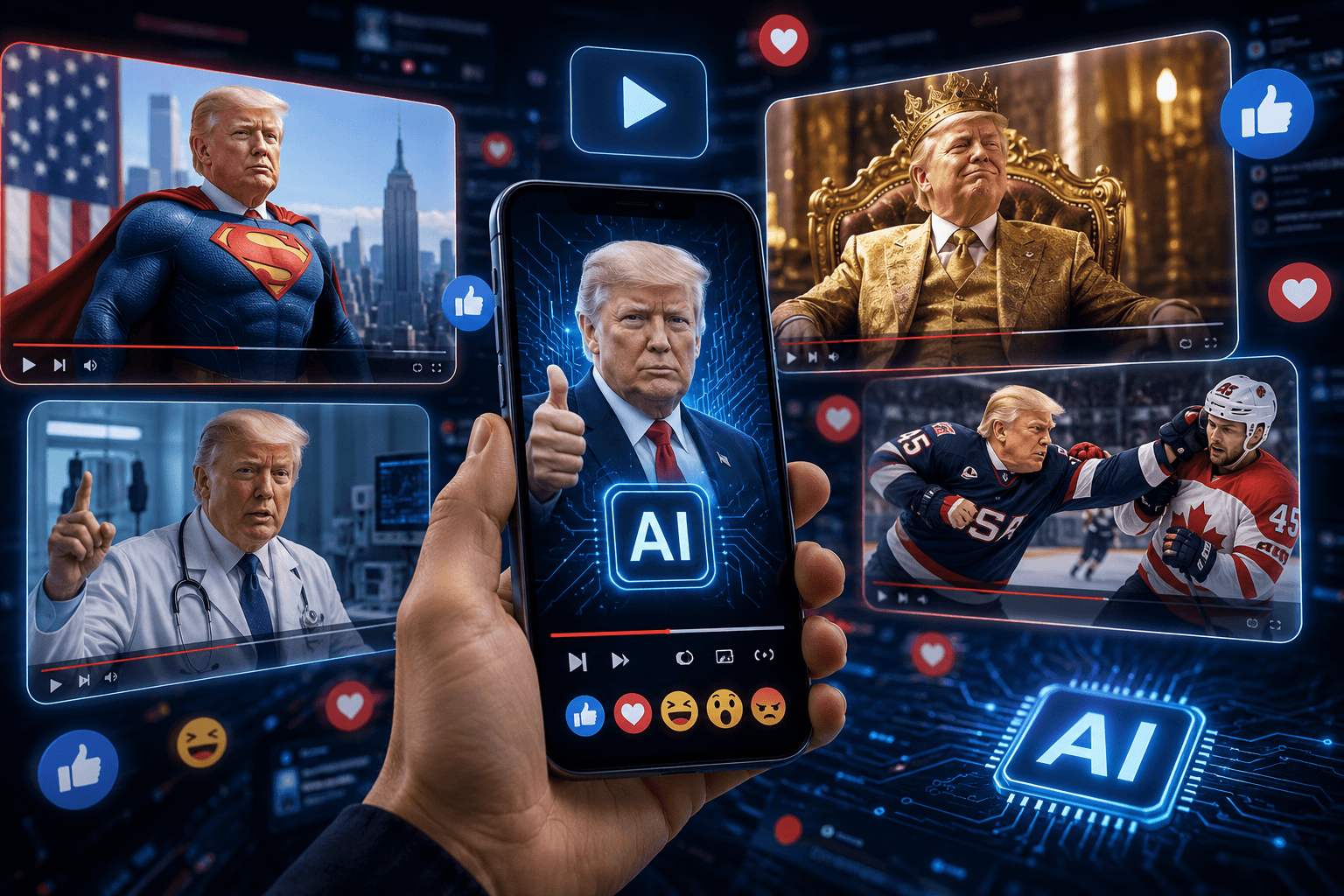
Over the past year, one recurring theme has kept surfacing across news feeds, social media timelines, and late-night talk shows: a Trump AI video. Whether it shows the president as a doctor, a superhero, or a hockey player throwing punches on the ice, these clips have become a defining part of how Donald Trump communicates online in his second term. What started as an occasional novelty has turned into a near-regular occurrence, and it raises real questions about how political figures are using generative AI tools to shape public perception, mock critics, and dominate news cycles.
This article breaks down what has actually happened, why these videos keep appearing, how the public and media have reacted, and what this trend says about the growing role of AI-generated content in modern politics.
A Pattern That Has Repeated Itself Throughout 2026
Trump has a long history of using social media, particularly Truth Social, as his primary communication channel. What has changed more recently is the format. Instead of relying solely on text posts or reposted news clips, a growing share of his content now comes in the form of AI-generated video, often built around exaggerated, meme-style scenarios.
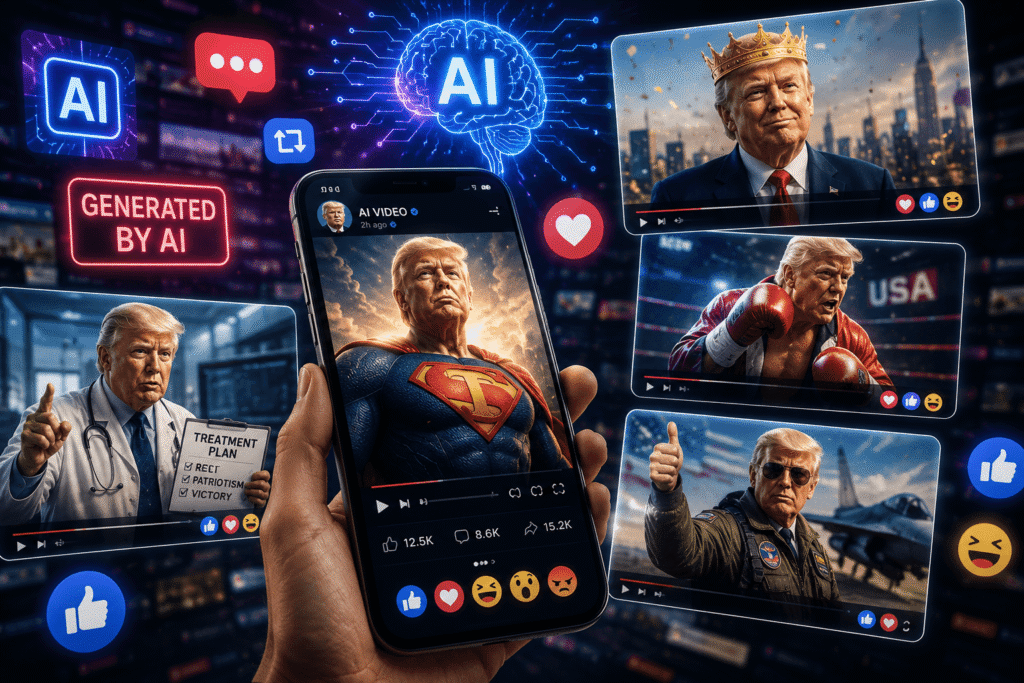
One of the most talked-about examples came in early July 2026, when Trump shared a clip depicting himself as a white coat-wearing doctor offering a mock “treatment plan” for what he refers to as “Trump Derangement Syndrome.” The video featured AI-generated versions of celebrity critics, including well-known actors and television personalities, appearing to endorse his fictional cure. It was posted late at night, a pattern that has become common with several of his most attention-grabbing posts.
This was far from an isolated case. Earlier in the year, following the U.S. hockey team’s Olympic gold medal win, Trump shared a Trump AI video showing himself skating alongside the team and getting into a fight with a Canadian player before scoring the winning goal. The clip leaned into his ongoing rivalry with Canadian political figures and was widely shared and mocked in equal measure across social platforms.
The Recurring Themes Behind These Videos
Looking across the various clips that have circulated, a few themes keep showing up. Many of the videos are designed to mock or belittle political opponents and celebrity critics, often through exaggerated or absurd scenarios rather than any attempt at realism. Others lean into nationalistic or celebratory themes, portraying Trump as victorious, heroic, or beloved on a global scale.
A smaller number of these posts have crossed into more controversial territory, drawing sharp criticism even from within his own political circle. One example involved a religious-themed AI image that sparked backlash for its imagery, which was eventually taken down. Another instance involved a video with racially insensitive content that also faced immediate condemnation before being removed. These moments illustrate that while many of the videos are treated as political theater or dark humor by supporters, others have generated real controversy and calls for more caution.
Why Is This Trend Happening Now
The rise of accessible, powerful AI video generation tools has made this kind of content dramatically easier and cheaper to produce than it would have been just a few years ago. What once required a production team and significant editing skill can now be generated in minutes using consumer-facing AI platforms. This lowers the barrier for any public figure, including a sitting president, to produce polished, shareable video content without relying on a traditional media team.
For a figure like Trump, who has built much of his political brand around directness, humor, and dominating the news cycle, AI video offers a new tool to do exactly that. Each new Trump AI video tends to generate significant media coverage on its own, regardless of whether the reaction is positive or negative, which in turn keeps him at the center of public conversation.
How the Public and Media Have Reacted
Reactions to these videos have been sharply divided. Supporters often treat the clips as entertaining, tongue-in-cheek content that reflects Trump’s willingness to poke fun at his critics and lean into internet culture. Critics, on the other hand, have raised concerns about a sitting president using deepfake-style content to mock private citizens and public figures, arguing that it blurs the line between humor and misinformation.
Fact-checking organizations have also had to step in at times, since not every AI video attributed to or involving Trump is authentic. In one widely circulated case, a fake video appeared to show Trump stumbling while getting into a vehicle, which spread rapidly online before being confirmed as an AI-manipulated clip based on real footage. This highlights a broader challenge tied to the Trump AI video phenomenon: once a public figure becomes closely associated with sharing AI-generated content, it becomes easier for bad actors to create convincing fakes and blend them into the same news cycle, making it harder for casual viewers to separate authentic posts from fabricated ones.
The Broader Political and Cultural Context
This trend does not exist in isolation. It reflects a larger shift in how political communication works in the age of generative AI. Politicians and public figures around the world have increasingly experimented with AI-generated imagery and video, whether for satire, campaign messaging, or simply grabbing attention in an oversaturated media environment.
What makes the Trump AI video trend particularly notable is the frequency and visibility of it, given that it involves the sitting president of the United States rather than a lower-profile political figure. It has also intersected with ongoing industry-wide debates about AI regulation, including efforts from the entertainment industry to push for stronger legal protections against unauthorized use of a person’s likeness in AI-generated content.
Concerns Around Deepfakes and Misinformation
The conversation around any Trump AI video inevitably touches on the larger issue of deepfake technology and its risks. Even when a video is intended as obvious satire, the underlying technology is the same used to create more deceptive, harmful deepfakes elsewhere. Critics argue that normalizing this kind of content from a high-profile figure, even in a joking context, could make audiences more susceptible to genuinely deceptive AI content down the line, since viewers become accustomed to seeing manipulated video attached to real public figures.
This concern is amplified by cases where a fake video, not actually posted by Trump himself, spreads under the assumption that it is real or officially connected to him. As AI tools continue to improve in realism, distinguishing satire, self-generated content, and malicious fabrication is likely to become an even bigger challenge for both platforms and everyday users.
What This Means for the Future of Political Communication
Whether viewed as a harmless meme trend or a concerning normalization of manipulated media, the rise of the Trump AI video phenomenon offers a preview of where political communication may be heading. As AI video tools become more capable and more widely available, it is likely that more political figures, at every level of government, will begin experimenting with similar content, whether for humor, campaigning, or rapid response to news events.
This raises important questions for platforms, journalists, and the public alike about labeling standards, disclosure requirements, and media literacy. Some platforms have already begun requiring AI-generated content to be labeled, though enforcement and consistency remain uneven across different social media services.
Final Thoughts
The Trump AI video trend has become one of the more distinctive features of political communication in 2026, blending humor, provocation, and cutting-edge technology into a format that consistently draws attention regardless of the reaction it produces. While some of these videos are dismissed as harmless jokes and others have sparked genuine backlash, the broader pattern reflects how quickly generative AI tools have been absorbed into mainstream political messaging. As the technology continues to advance, the conversation around authenticity, labeling, and responsible use is only likely to grow louder.
Frequently Asked Questions
What is the Trump AI video trend?
It refers to a pattern of AI-generated video clips shared by President Trump on social media, often depicting him in exaggerated or humorous scenarios aimed at critics or current events.
Are all the Trump AI videos actually posted by him?
No. While many are shared directly from his own accounts, some viral clips attributed to him have turned out to be fabricated by other parties and later debunked by fact-checkers.
Why has Trump faced criticism over some of these videos?
A few clips have included content seen as racially insensitive or religiously controversial, drawing backlash even from some political allies before being removed.
What technology is used to create these videos?
These clips are typically produced using consumer-accessible generative AI video tools capable of creating realistic or stylized video content from text prompts or reference images.
Is this kind of AI video content legal?
Generally, yes, particularly when clearly intended as satire or commentary, though ongoing legislative efforts aim to strengthen protections against unauthorized use of someone’s likeness in AI content.
How can viewers tell if a Trump AI video is real or fake?
Checking for official verification from Trump’s own accounts, looking for fact-checks from reputable organizations, and watching for visual inconsistencies are all useful steps, though this is becoming harder as AI realism improves.
Is this trend unique to Trump?
No. While Trump’s frequent use of AI video has drawn significant attention due to his high profile, political figures and public personalities worldwide have increasingly experimented with similar AI-generated content.
